


NEWS CENTER
Oasis Iceberg
13
2024
-
07
Counterflow Closed-Circuit Cooling Tower
A closed-circuit cooling tower is an industrial cooling device with a very wide range of applications. It comes in three cooling configurations: counterflow closed-circuit cooling towers, crossflow closed-circuit cooling towers, and hybrid-flow closed-circuit cooling towers.
A closed-circuit cooling tower is an industrial cooling device with a very wide range of applications. It comes in three types of cooling configurations: counterflow closed-circuit cooling towers, crossflow closed-circuit cooling towers, and hybrid-flow closed-circuit cooling towers.
Today, let’s focus on understanding counterflow closed cooling towers.
I: Overview
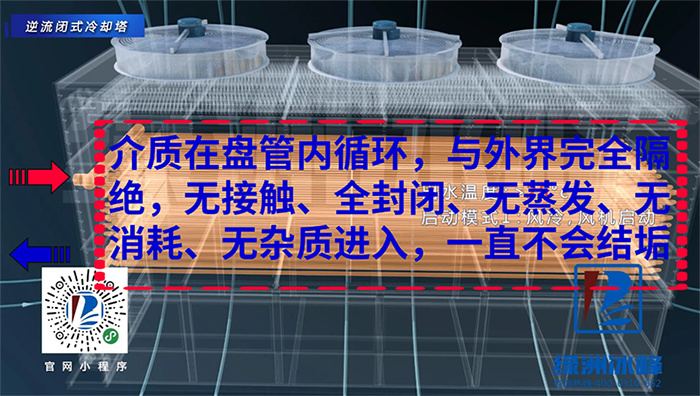
The counterflow closed-circuit cooling tower is named so because the coolant and the heated medium flow in opposite directions. The spray water is sprayed from top to bottom, while air flows rapidly upward from bottom to top.
It mainly consists of a heat exchange coil, a spray water system, an exhaust ventilation system, and a frame enclosure.
II. Work Process
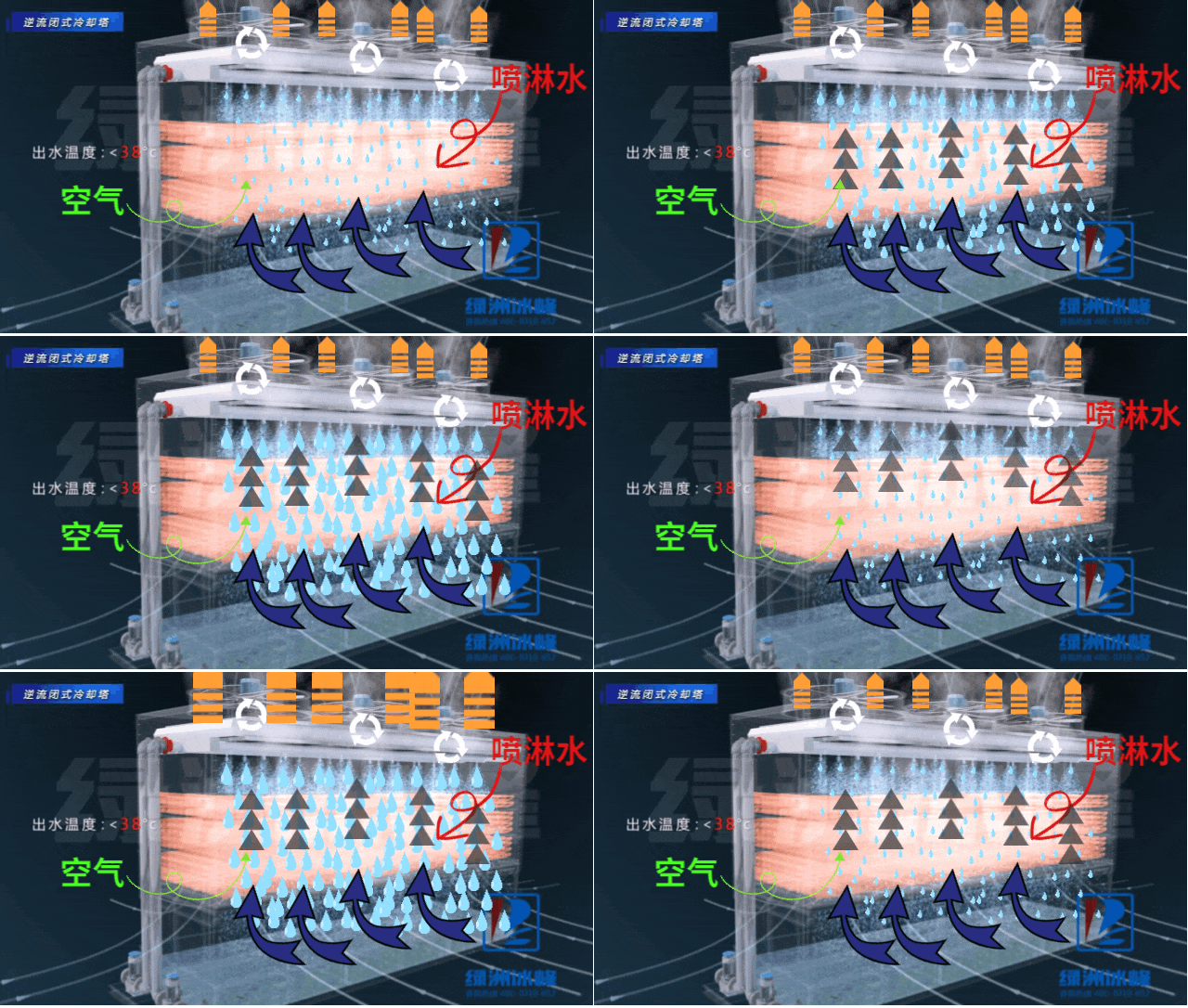
1. The spray pump draws water from the sump and pumps it to the upper part of the heat-exchange coil, where it is sprayed in an umbrella-like pattern through nozzles, continuously and uniformly covering the outer surface of the pipe material and forming a thin water film. Some of this water absorbs heat from the cooling medium inside the pipe, causing the liquid water to turn into gaseous steam. As the steam evaporates, it carries away heat, thereby cooling the internal cooling medium or condensing it back into liquid form. The spray water that has not yet evaporated falls back into the spray water sump.
2. Ventilation System: The fan at the top of the tower is an induced-draft type, drawing air from inside the tower and discharging it outward. Outside, cool, dry air enters the tower through the air intake grille, where it is filtered to remove debris before flowing upward through the bottom of the heat-exchange coil. This airflow carries away the water vapor that has already been evaporated, increasing both the humidity and temperature of the air, which is ultimately discharged from the tower by the fan.
3. A float valve is installed in the spray water tank to automatically replenish water when the water level drops, ensuring that the tank maintains a constant water level.
4. Electrical control: The system continuously monitors the outlet temperature of the cooled medium and feeds this data back to the data processing center. Based on the cooled medium’s temperature, it automatically controls the start and stop of the spray pump and the fan, thereby achieving energy-saving goals.
3: Working Principle
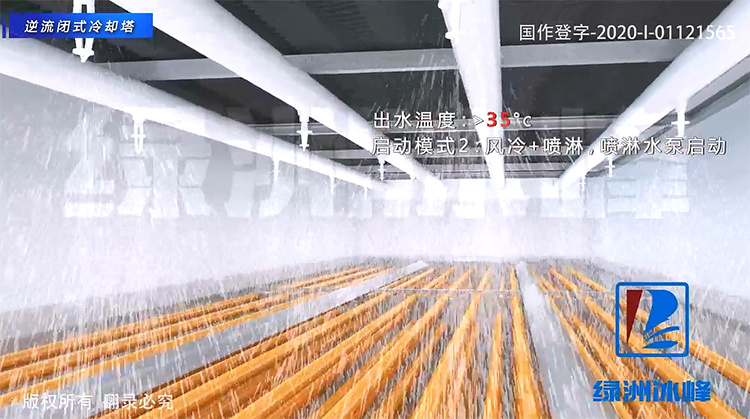
1. Internal Circulation: The circulating water, after being heated by the heat source equipment, flows into the cooling coil, where it undergoes interfacial heat exchange. The cooled circulating water is then pumped back to the heat source equipment by a water pump.
2. External Circulation: The spray water is pumped from the sump to the spray system. After being sprayed, the water comes into contact with the cooling coil and undergoes evaporative heat exchange. The moist, hot steam is then exhausted by a fan. The unevaporated spray water falls back into the sump and is subsequently pumped back to the spray system via a water pump, initiating another cycle.
Four: Characteristics of Counterflow Closed-Circuit Cooling Towers

1. Compact structure: Compared to crossflow towers, counterflow towers feature a more compact product design with a greater arrangement of coil surface area for heat dissipation, making them particularly suitable for cooling applications characterized by small temperature differences and high flow rates.
2. Overall System: Since cooling towers occupy a relatively small footprint, and with the addition of a circulating water pump, the system can be integrated into a single unit for easy mobility.
3. Scope of Application: Due to the compact design of the tower, it can be placed directly in the workshop; therefore, cooling with medium-frequency power supplies and mechanical water jackets is particularly suitable. It is especially well-suited for projects with small temperature differences, such as the cooling of groups of water-source heat pump units.
5: Advantages of Counterflow Closed-Circuit Cooling Towers
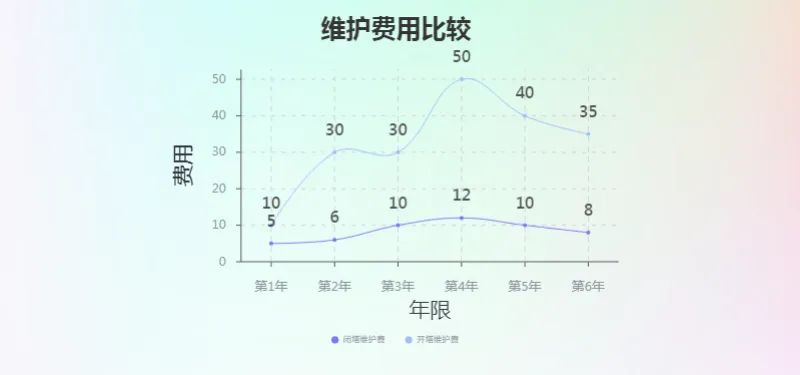
1. Stability: Closed-circuit cooling towers typically use softened water for closed-loop circulation, effectively preventing scale buildup inside the tower or in user equipment over long-term operation and thereby avoiding damage to the equipment.
2. Water Conservation: Compared to conventional cooling towers, closed-circuit cooling towers are better suited for use in regions with scarce water resources, thanks to their fully enclosed internal circulation system and highly efficient dehydrating devices.
3. Energy Efficiency: Closed-circuit cooling towers can control the number of fans that are started based on temperature, as well as the on/off status of the spray pumps. Additionally, regulating valves can be installed to control the flow rate.
4. Environmental Protection: Closed-circuit cooling towers use a fully enclosed internal water circulation system that prevents water contamination, ensuring sustainable use. The spray water has relatively low evaporation, thereby maximizing environmental protection.
5. Longer service life: Our company adopts industry-leading quality inspection standards, significantly enhancing corrosion resistance. With proper use and maintenance, the typical service life exceeds 10 years, and subsequent maintenance and costs are relatively low.
Previous Page



Oasis Bingfeng Fluid Equipment Co.,Ltd
Contact Phone:+86 4000 616 676
Fax:+86 0310 3178005
E-mail:sales@hdbingfeng.com
Contact Address:No.1, Happiness Road, Feixiang Economic Development Zone, Handan City, Hebei Province
Copyright©2024 Oasis Bingfeng fluid equipment co., ltd