

Evaporative condenser
An evaporative condenser is a common, informal term for a closed-circuit cooling tower. In fact, it is precisely a closed-circuit cooling tower: it uses the evaporation of sprayed water, carried away by air outside the tower, to cool and exchange heat with the circulating medium inside the heat-exchange tubes. The circulating medium remains completely isolated from the external environment. Because the circulating medium being cooled is entirely sealed off from the outside world, it is sometimes referred to as an evaporative condenser. The internal circulating medium is only cooled—there is no consumption or evaporation. After the spray water on the exterior of the heat-exchange tubes vaporizes, a large amount of water vapor mixes with the air, increasing the humidity. An axial-flow fan then draws this saturated, high-humidity, high-enthalpy air out of the tower and into the surrounding environment.
Key words:
Evaporative condenser
Classification:
Hotline:
Evaporative condenser
Overview
An evaporative condenser is a common name for a closed cooling tower.
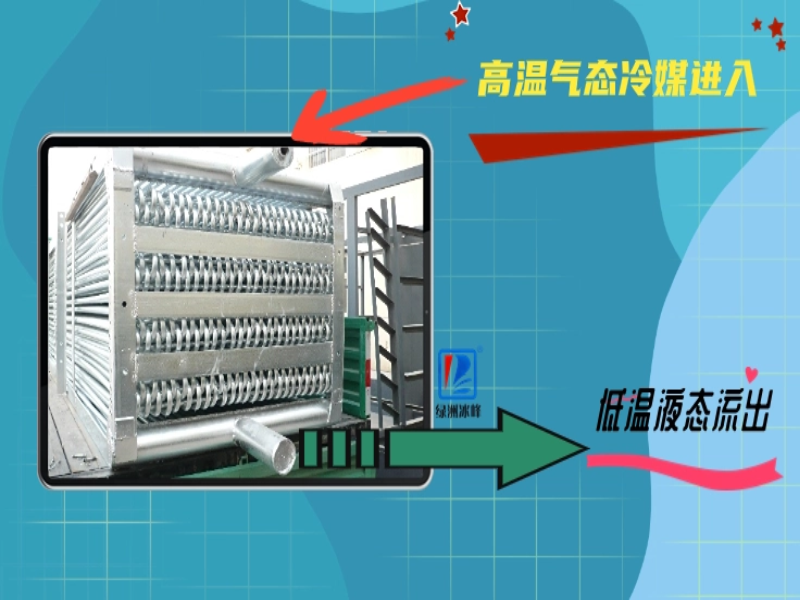
In fact, it’s simply a closed-circuit cooling tower. It uses the evaporation of spray water, carried away by air outside the tower, to cool and exchange heat with the circulating medium inside the heat-exchange tubes. The circulating medium is completely isolated from the external environment.
Since the cooled circulating medium is isolated from the outside environment and completely sealed, it is sometimes referred to as an evaporative condenser. The internal circulating medium is only cooled—there is no consumption and no evaporation.
After the spray water on the outside of the heat exchange tubes vaporizes, a large amount of steam mixes with the air, increasing the humidity. An axial-flow fan then draws this saturated, high-humidity, high-enthalpy air out of the tower and into the surrounding environment.
Work process
► Latent heat of vaporization: Similar to that of a closed-circuit cooling tower, it relies on the evaporation of spray water outside the heat-exchange tubes to absorb the latent heat of vaporization and carry away the thermal energy from the industrial circulating water medium within the enclosed heat-exchange tubes.
► Baffle heat exchange: The spray water and air are completely isolated from the circulating medium, with no direct contact whatsoever—only heat transfer occurs, without any physical contact.
Main advantages
► No evaporation: It only cools down without any evaporation or consumption. The circulating medium is completely isolated from the external air, with no direct contact whatsoever. There is neither evaporation nor consumption of the medium, and no impurities enter the system, ensuring the stability of the internal medium composition.
► No scaling: Since there is no evaporation, the concentrations of scale-forming ions such as calcium, magnesium, and sulfate in the medium remain unchanged, thus preventing scaling.
► No algae growth, excellent environmental performance;
► Saves water, electricity, and worry. During winter and spring when temperatures are low, there may be no need to spray water—air cooling alone can meet the cooling requirements, resulting in significant water savings. It operates automatically without manual intervention; when the temperature reaches the set point, the spray pump or fan will automatically stop.
Application scenarios
Widely used in heavy industries such as iron and steel metallurgy, casting and smelting, petrochemicals, chemical fiber and light industry, and mechanical and electrical engineering, this system is resistant to scaling and reduces evaporation. It is commonly employed for cooling desalinated water and purified water, with the cooling process taking place within a closed heat-exchange tube that is completely isolated from the external atmosphere.
► Iron and steel metallurgy: blast furnaces, continuous casting and rolling, crystallizers, air compressors, etc.;
► Large-scale casting: melting furnaces, frequency converters, quenching fluids, etc.;
► Petroleum refining: reaction vessels, refining furnaces, heat exchangers, etc.;
► Chemical industry and light textiles: reaction kettles, etc.;
► Air conditioning cooling: compressor, etc.;
Add Sales Engineer WeChat Work: Get technical copywriting for free.
Previous Page
Next Page
Previous Page
Next Page
Related Products
Leave us a message



Oasis Bingfeng Fluid Equipment Co.,Ltd
Contact Phone:+86 4000 616 676
Fax:+86 0310 3178005
E-mail:sales@hdbingfeng.com
Contact Address:No.1, Happiness Road, Feixiang Economic Development Zone, Handan City, Hebei Province
Copyright©2024 Oasis Bingfeng fluid equipment co., ltd